February 19, 2026
Building India’s space supply chain:
The multibillion-dollar opportunity for SpaceTech Startups

Arindam Mukhopadhyay
Partner @ VC | India Accelerator & Finvolve | Seed to pre-IPO
Index
Building India’s space supply chain: The multibillion-dollar opportunity for SpaceTech Startups
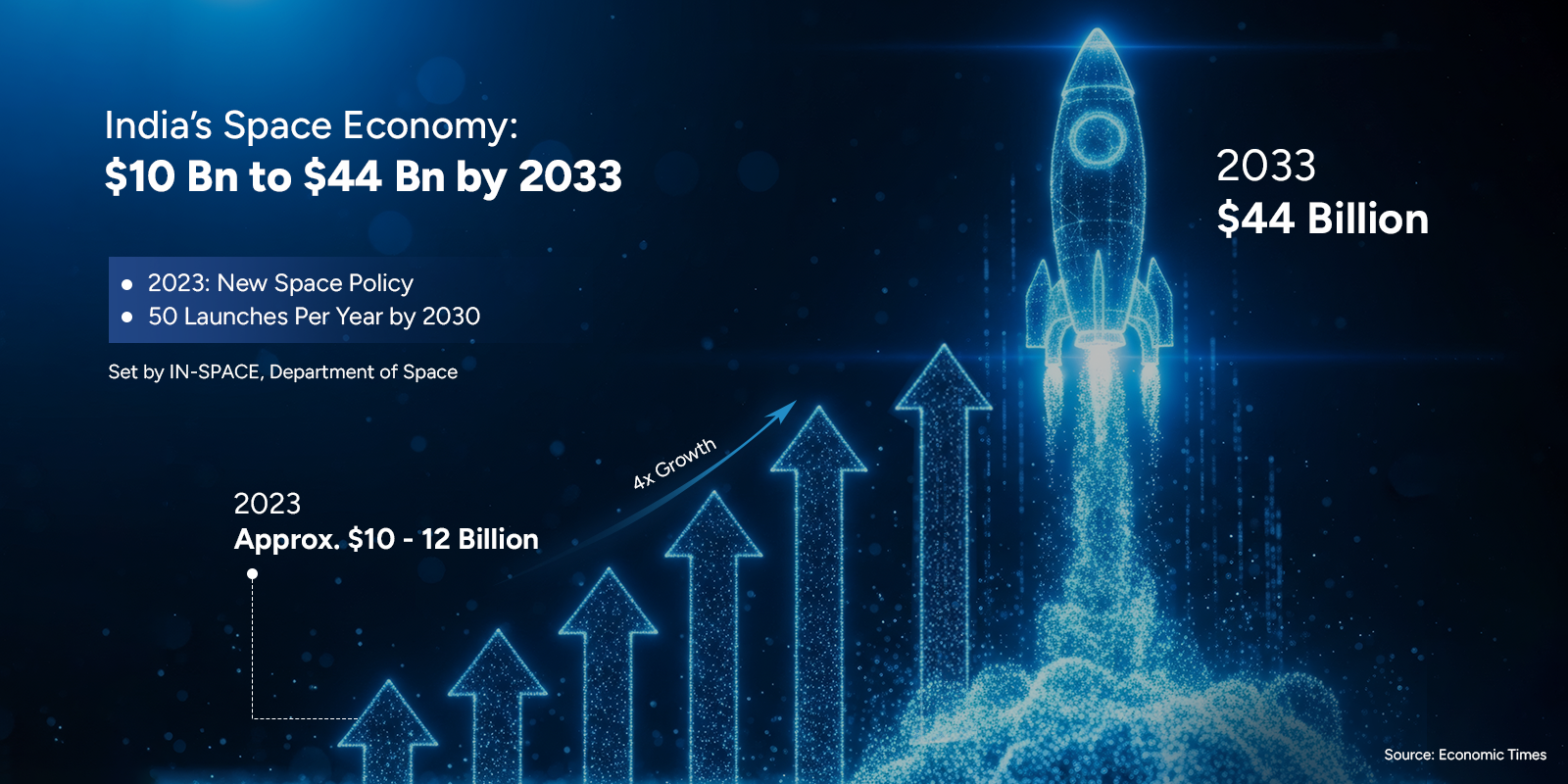
India’s space economy has been undergoing a shift since the Space Policy came into effect in 2023. For the first time in history, space exploration has been made open for pvt companies to participate. Along with it, the budgetary support and availability of pvt capital have made India a global hub for space tech innovation.
IN-SPACe, which is an autonomous agency set up under the Department of Space (DoS), has set ambitious goals of $44 Billion space economy for India by 2033, which is a significant jump from where it is today, roughly $10-12B.
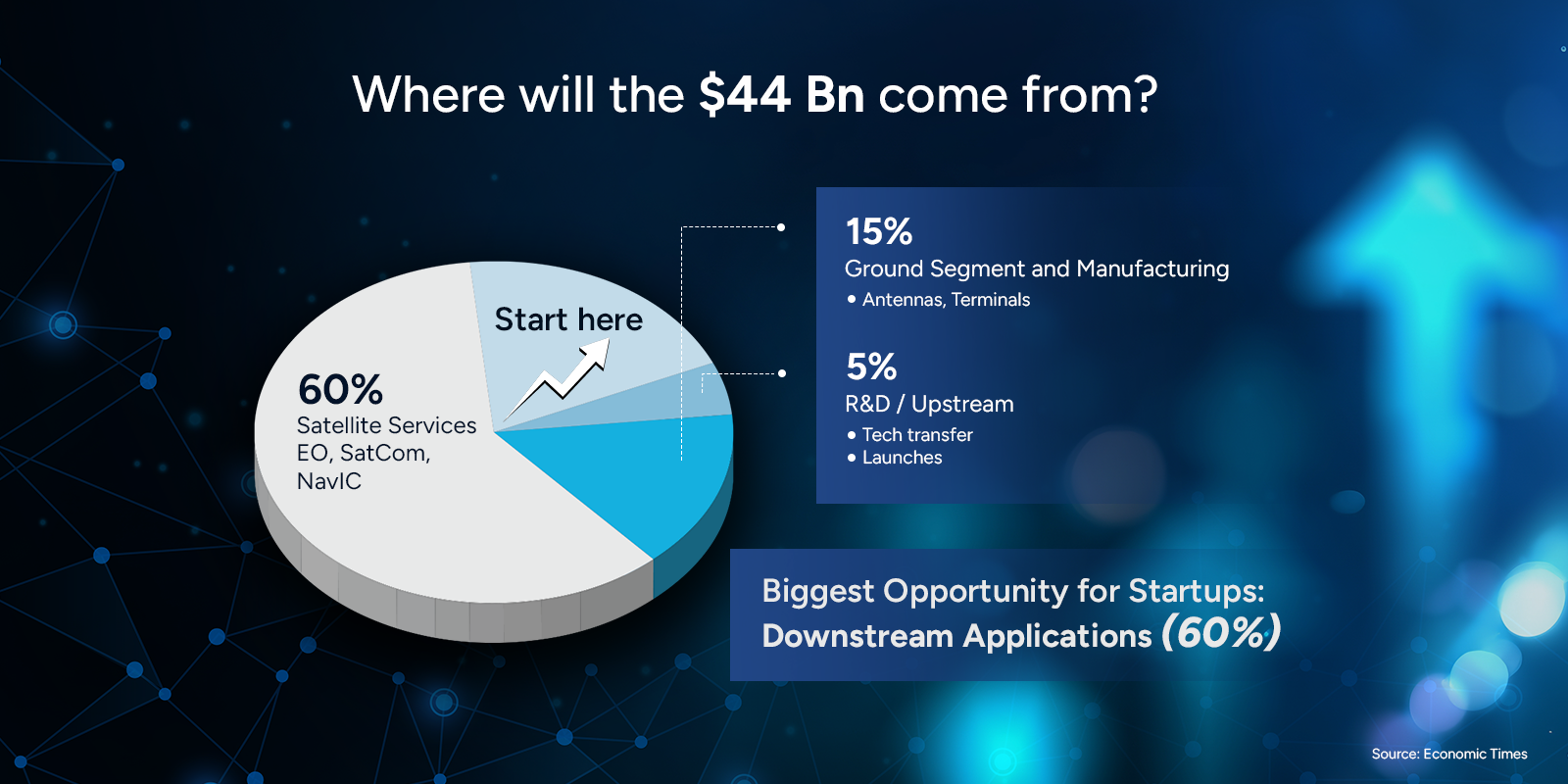
As per CII, EY, and FICCI reports, the $44B goal relies on four major pillars.
- Satellite Services (60%): EO analytics, SatCom broadband, NavIC PNT apps integrated into Gati Shakti/Ayushman Bharat.
- R&D/Upstream (5%): ISRO tech transfer, GagaGaganyaanares, commercial launches by NSIL.
- Ground Segment/Manufacturing (15%): User terminals, antennas, PLI for components.
- R&D/Upstream (5%): ISRO tech transfer, Gaganyaan/BAS precursors.
The Rise of India’s 500+ SpaceTech Startups
Since the Space Policy came in, India’s spacetech startups have surged in numbers. There are more than 500 spacetech startup today, and enthusiastic space entrepreneurs are working on interesting problem statements ranging from rocket engines, launch vehicles, satellite systems, various subsystem electronics sensors, and payloads.
While these are significant progress as indigenous capabilities in these areas are critical, it is important to note that the bulk of India’s $44B space economy is expected to come from the downstream data and communication applications, where lie the biggest opportunities for the startups in India.
As the imaging technology has improved multifold, satellite imageries have become an essential ingredient to analyse the surface of the earth.
Why the Real Opportunity Lies in Downstream Applications
Today, satellites are capable of taking high-resolution imagery using hyperspectral cameras and overlaying it with images taken by other sensors, whether infrared (IR) or synthetic aperture radar (SAR) or normal optical sensor cameras, to create a more meaningful interpretation of the satellite data. This has a wide range of applications, starting from defence, to disaster management, to agriculture, mining, and other industrial sectors.
Defence is using satellite data as a strategic tool to monitor land and sea. Through AI and ML, it is possible to identify and classify any object, its movement, and direction, along with specific details such as its country of origin, whether it's civilian or military, and the type of instruments they carry. Until very recently, India had to depend on other countries to purchase such imageries and insights, but the good news is that Indian startups are making fast progress to build similar capabilities.
Another area to focus on is the data latency. These satellites are rotating the earth at low earth orbit (LEO), and there is an inherent time gap when a satellite is able to take images of a particular point on earth, which goes up to a few days. Another factor is the latency in relaying the data back to earth, which is possible only for a few minutes in a day when the satellite is able to establish a connection with the earth's ground station.
Building a Cohesive Ecosystem: The Next Phase of India’s Space Supply Chain
To overcome both challenges, India needs to put a far greater number of satellites on the orbit. To draw a comparison, India has more than 50 satellites in orbit, whereas China has close to 1,000, and the USA has almost 10,000. That gives these countries a unique ability to see across the earth's surface and relay the data back to the ground station in near real time. This is a huge strategic advantage for a country and hence India is actively working towards that as well. In fact, India has ambitious goals to reach a 50 launches a year target by 2030 from 5 launches a year as of today, and pvt players, including startups, are going to play a crucial role in achieving this.
India’s spacetech ecosystem is evolving rapidly across the value chain. The sector’s institutional and regulatory efforts are increasingly aligned toward building a cohesive environment that enables private participation and sustained innovation. While the current focus of spacetech founders is on building the rocket engines and launch systems, more founders should start looking into the data and communication aspect seriously, as it not only has huge potential business opportunities, but also gives the necessary strategic advantage to our country in the near future.
Check Out More Blogs
Drones, AI and the New Battlefield: How Indian Startups Are Modernising National Security
Nations are rapidly shifting conflict to the skies and cyberspace, and traditional defence systems no longer guarantee strategic advantage.
![[object Object]](/_next/image/?url=https%3A%2F%2Fwebsite.indiaaccelerator.live%2Fwp-content%2Fuploads%2F2026%2F04%2FWhatsApp-Image-2026-04-01-at-10.45.24-AM-2.jpeg&w=3840&q=75)
The Case for Sovereign Foundation Models in India
Artificial intelligence is rapidly becoming the infrastructure layer of the digital economy, and foundation models are the engines powering it.
![[object Object]](/_next/image/?url=https%3A%2F%2Fwebsite.indiaaccelerator.live%2Fwp-content%2Fuploads%2F2026%2F03%2FWhatsApp-Image-2026-03-24-at-12.16.09-PM.jpeg&w=3840&q=75)
The EHR Was Built for Billing, Not Care. A New Wave of Startups Is Fixing That with LLMs
![[object Object]](/_next/image/?url=https%3A%2F%2Fwebsite.indiaaccelerator.live%2Fwp-content%2Fuploads%2F2026%2F03%2FWhatsApp-Image-2026-03-18-at-2.51.26-PM.jpeg&w=3840&q=75)
![[object Object]](/_next/image/?url=https%3A%2F%2Fwebsite.indiaaccelerator.live%2Fwp-content%2Fuploads%2F2026%2F03%2FBlog-Banner-4.5.png&w=3840&q=75)
Building India’s space supply chain:
The multibillion-dollar opportunity for SpaceTech Startups
![[object Object]](/_next/image/?url=https%3A%2F%2Fwebsite.indiaaccelerator.live%2Fwp-content%2Fuploads%2F2026%2F02%2FWhatsApp-Image-2026-02-25-at-6.13.13-PM-1.jpeg&w=3840&q=75)
India’s Next Deeptech Frontier
Semiconductors, Photonics, FPGA & Intelligent Software
![[object Object]](/_next/image/?url=https%3A%2F%2Fwebsite.indiaaccelerator.live%2Fwp-content%2Fuploads%2F2025%2F11%2FWhatsApp-Image-2025-11-27-at-11.47.44_0683d5c9.jpg&w=3840&q=75)
The Next Battlefield: How AI Is Redefining Modern Warfare
With the rise of artificial intelligence, even warfare is beginning to take an AI-first approach.
![[object Object]](/_next/image/?url=https%3A%2F%2Fwebsite.indiaaccelerator.live%2Fwp-content%2Fuploads%2F2025%2F08%2F1747893109578.png&w=1920&q=75)
Are we any better than monkey?
We are just an advanced breed of monkeys on a minor planet of a very average star. But we can understand the (Startup) Universe. That makes us something very special.
![[object Object]](/_next/image/?url=https%3A%2F%2Fwebsite.indiaaccelerator.live%2Fwp-content%2Fuploads%2F2025%2F01%2FGroup-43299-1.png&w=640&q=75)
The Future of Electric Mobility in India: Key Insights from 2024
As a VC fund focused on mobility and EV innovation, we’ve evaluated 500+ startups and engaged deeply with over 100 founders and industry leaders this year. Through these interactions, we’ve observed incredible momentum and inspiring stories shaping the future of electric mobility in India. The ecosystem has made impressive progress, from localized battery innovations to disruptive last-mile solutions. However, challenges in affordability, infrastructure, and technology integration persist, leaving significant room for innovation and reform.
![[object Object]](/_next/image/?url=https%3A%2F%2Fwebsite.indiaaccelerator.live%2Fwp-content%2Fuploads%2F2025%2F01%2FElectric-Mobility.png&w=640&q=75)
Abhimanyu must get out this time
Stepping into the entrepreneurial world takes courage and skill, but successfully navigating its challenges and achieving a successful exit requires a blend of strategy, adaptability, and support.
![[object Object]](https://website.indiaaccelerator.live/wp-content/uploads/2025/01/Abhimanyu.svg)