March 3, 2026
Why the Next Decade of Venture Returns Will Be Driven by Frontier & Strategic Technologies


Index
Introduction
For decades, venture capital returns were driven largely by software, fast scaling, low capex, and rapid exits. That era isn’t over, but it is no longer sufficient. The next decade of outsized venture returns will be driven by frontier & strategic technologies, deeply technical, capability-building innovations that reshape industries, supply chains, and national competitiveness.
BCG’s recent analysis of ~1,100 venture funds makes this shift undeniable. Over the last five years, traditional VC funds delivered a weighted average IRR of ~21%, while deep tech–focused funds generated ~26%. That ~5 percentage-point delta, nearly 24% higher on a relative basis, is material at the fund level, especially over long horizons.
(Source: https://www.bcg.com/publications/2023/deep-tech-investing)
This challenges a long-held belief: that deep tech is too slow, too risky, and too capital-intensive. In reality, the so-called ‘easy’ software bets are increasingly crowded, while the ‘hard’ bets are producing superior risk-adjusted outcomes.
The paradox is simple: higher technical risk often comes with lower market risk and greater long-term defensibility.
Deep Tech Advantage: Fewer Competitors, Stronger Moats
Frontier technologies operate in terrains that few companies can survive in. Once a hard technical problem is solved, switching costs become prohibitive, regulatory and strategic value increases, and winners often capture an outsized share. Many deep tech markets naturally evolve into winner-take-most, or even winner-take-all, outcomes.
Timing, however, is decisive. Deep tech involves long R&D cycles, regulatory arcs, and infrastructure dependencies. Enter too early, and capital runs out before markets mature. Enter too late, and the strategic edge is gone. In deep tech investing, timing is not a factor; it is the factor.
The Shift Toward Physical and Strategic Innovation
- The next wave of innovation is unmistakably physical and deeply technical:
- Manufacturing: Physical AI, AI-driven production
- Biotech: Gene therapies, longevity science, synthetic biology
- Compute: Compound semiconductors, quantum, neuromorphic, and photonic chips
- Space: Launch systems, in-space manufacturing, resource extraction
- Advanced Materials & Energy: Graphene, metamaterials, superconductors, fusion, next-gen batteries.
- These are not digital conveniences. They are strategic industries, hard to offshore, replicate, or commoditize. As a result, governments and investors are converging on them for three tightly linked reasons: economic security, geopolitical competition, and strategic necessity.
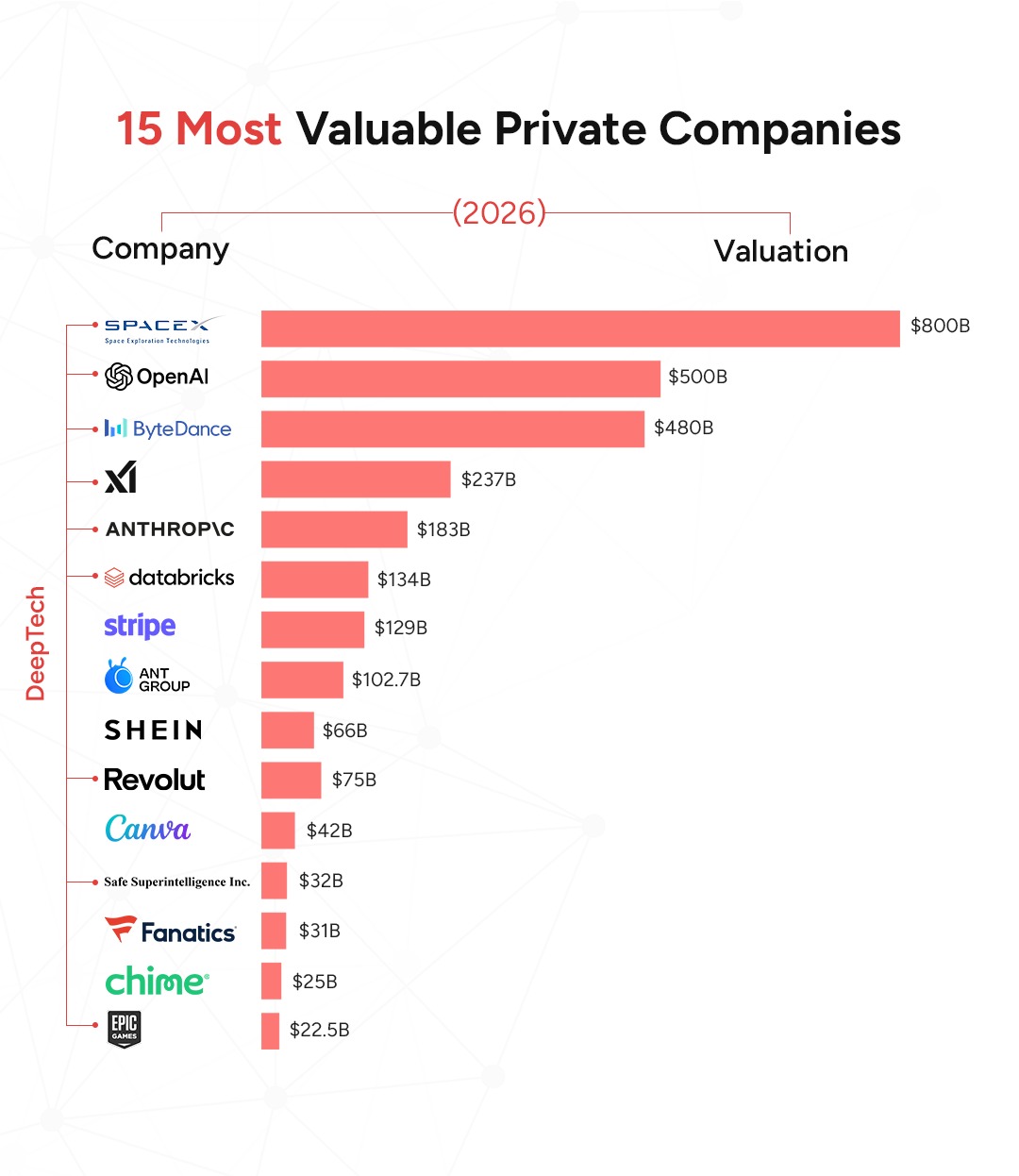
- When you look around in the private startup space, the 15 most valuable companies by their valuation include 8 deep tech startups.
India’s Moment: From Services to Strategic Technologies
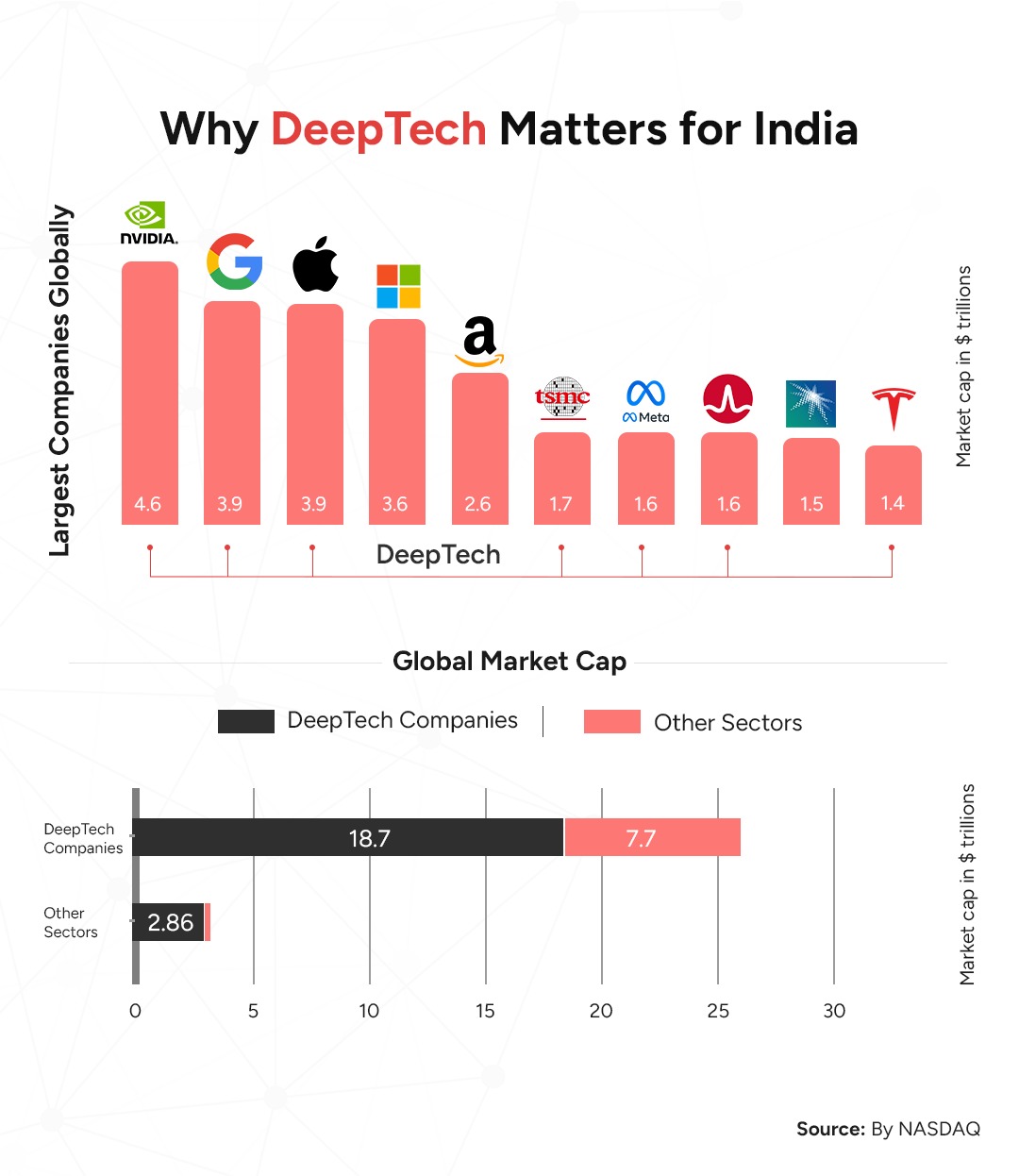
Startups founded two to three decades ago now dominate the NASDAQ. In contrast, India’s Sensex and Nifty have seen limited turnover, with Infosys being a rare exception from the services era. This gap signals opportunity.
As India approaches 2047, the next generation of leaders will emerge from strategic technologies in India, not services alone. The conditions, policy backing, talent depth, capital efficiency, and market scale are finally aligned for deeptech innovation in India to create globally dominant companies.
What Are Frontier & Strategic Technologies?
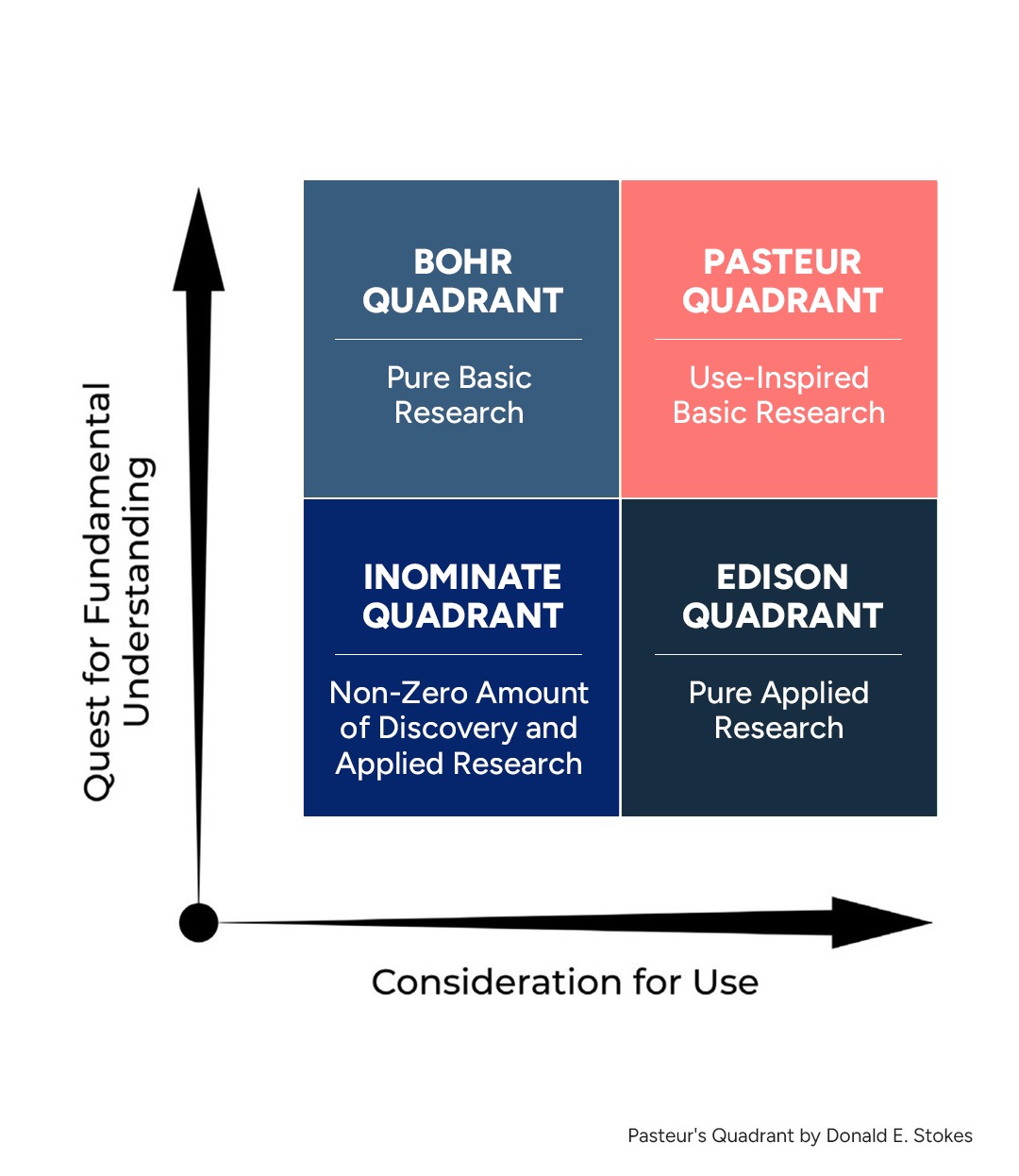
- Deep Tech is rooted in scientific and engineering breakthroughs that address fundamental human and industrial challenges, combining research depth with a clear path to market. These innovations sit across two dimensions:
- Basic Science (Fundamental Understanding) – curiosity-driven research
- Applied Science (Use-Inspired)—problem-driven innovation
- This framework maps into three relevant quadrants:
- Bohr’s Quadrant: Understanding without immediate use (e.g., quantum error correction, superconducting materials)
- Edison’s Quadrant: Application without new science (e.g., drones, AI-led SaaS)
- Pasteur’s Quadrant: Use + Understanding, where deep tech venture value is created (e.g., quantum computing, photonics, compound semiconductors, longevity science)
The Five Pillars of Frontier & Strategic Technologies
Frontier & strategic technologies form the backbone of long-term economic growth, technological sovereignty, and national security. This thesis focuses on five interlinked pillars:
1. Artificial Intelligence & Cognitive Systems
AI is moving beyond text into perception, autonomy, and decision-making. Voice, vision, video, and agentic systems are becoming core infrastructure for enterprises, governments, and critical systems, especially in multilingual, mobile-first markets like India.
2. Semiconductors & Advanced Hardware
Semiconductors are now a strategic infrastructure. India’s opportunity lies in fabless design, compound semiconductors, photonics, RF systems and equipment subsystems, high-value choke points aligned with policy, and global supply-chain realignment.
3. Quantum & Next-Gen Computing
Quantum is a foundational shift unlocking new classes of problems in security, materials, finance, and defense. With strong state backing and deep scientific talent, India is positioned to be a Global South quantum hub in the areas of quantum computing, quantum communications, quantum cryptography, and quantum sending.
4. Cybersecurity & Sovereign Stack
Cybersecurity, computing, and AI stacks are now matters of national resilience. Sovereign cyber, sovereign compute, and sovereign AI are inevitable investment themes driven by regulation, data localization, and infrastructure lock-in.
5. Advanced Manufacturing & Physical AI
Advanced materials, additive manufacturing, NDE, digital twins, Robotics, and logistics tech fuse intelligence with the physical world, creating resilient supply chains and next-generation industrial capabilities.
Why This Matters for Venture Returns
Frontier and strategic technologies are not incremental innovations. They are capability-building platforms with high barriers to entry, long product lifecycles, and strong strategic demand. Returns are driven by deep IP, regulatory and infrastructure lock-in, and strategic M&A, not just IPOs.
For investors, this creates asymmetric upside with downside protection. For India, it represents a once-in-a-generation opportunity to lead in deeptech innovation in India and build enduring global champions.
The next decade of venture returns will not come from what is easiest to build, but from what is hardest to replace.
The Takeaway
India’s deeptech evolution marks a critical shift from services to systems, from cost arbitrage to strategic capability. Frontier and strategic technologies are no longer peripheral bets; they are becoming the backbone of India’s next growth cycle. As global supply chains realign and nations seek trusted, scalable partners, India stands at a rare inflection point.
The winners of this wave will be those who can blend deep science, real-world use cases, and scalable execution to turn innovation into long-term impact.
Are you ready to build the next deeptech game-changer? How will your startup shape India’s innovation landscape?
Feel free to write to us at applications@indiaaccelerator.co—we’re always happy to start the conversation.
Check Out More Blogs
Drones, AI and the New Battlefield: How Indian Startups Are Modernising National Security
Nations are rapidly shifting conflict to the skies and cyberspace, and traditional defence systems no longer guarantee strategic advantage.
![[object Object]](/_next/image/?url=https%3A%2F%2Fwebsite.indiaaccelerator.live%2Fwp-content%2Fuploads%2F2026%2F04%2FWhatsApp-Image-2026-04-01-at-10.45.24-AM-2.jpeg&w=3840&q=75)
The Case for Sovereign Foundation Models in India
Artificial intelligence is rapidly becoming the infrastructure layer of the digital economy, and foundation models are the engines powering it.
![[object Object]](/_next/image/?url=https%3A%2F%2Fwebsite.indiaaccelerator.live%2Fwp-content%2Fuploads%2F2026%2F03%2FWhatsApp-Image-2026-03-24-at-12.16.09-PM.jpeg&w=3840&q=75)
The EHR Was Built for Billing, Not Care. A New Wave of Startups Is Fixing That with LLMs
![[object Object]](/_next/image/?url=https%3A%2F%2Fwebsite.indiaaccelerator.live%2Fwp-content%2Fuploads%2F2026%2F03%2FWhatsApp-Image-2026-03-18-at-2.51.26-PM.jpeg&w=3840&q=75)
![[object Object]](/_next/image/?url=https%3A%2F%2Fwebsite.indiaaccelerator.live%2Fwp-content%2Fuploads%2F2026%2F03%2FBlog-Banner-4.5.png&w=3840&q=75)
Building India’s space supply chain:
The multibillion-dollar opportunity for SpaceTech Startups
![[object Object]](/_next/image/?url=https%3A%2F%2Fwebsite.indiaaccelerator.live%2Fwp-content%2Fuploads%2F2026%2F02%2FWhatsApp-Image-2026-02-25-at-6.13.13-PM-1.jpeg&w=3840&q=75)
India’s Next Deeptech Frontier
Semiconductors, Photonics, FPGA & Intelligent Software
![[object Object]](/_next/image/?url=https%3A%2F%2Fwebsite.indiaaccelerator.live%2Fwp-content%2Fuploads%2F2025%2F11%2FWhatsApp-Image-2025-11-27-at-11.47.44_0683d5c9.jpg&w=3840&q=75)
The Next Battlefield: How AI Is Redefining Modern Warfare
With the rise of artificial intelligence, even warfare is beginning to take an AI-first approach.
![[object Object]](/_next/image/?url=https%3A%2F%2Fwebsite.indiaaccelerator.live%2Fwp-content%2Fuploads%2F2025%2F08%2F1747893109578.png&w=1920&q=75)
Are we any better than monkey?
We are just an advanced breed of monkeys on a minor planet of a very average star. But we can understand the (Startup) Universe. That makes us something very special.
![[object Object]](/_next/image/?url=https%3A%2F%2Fwebsite.indiaaccelerator.live%2Fwp-content%2Fuploads%2F2025%2F01%2FGroup-43299-1.png&w=640&q=75)
The Future of Electric Mobility in India: Key Insights from 2024
As a VC fund focused on mobility and EV innovation, we’ve evaluated 500+ startups and engaged deeply with over 100 founders and industry leaders this year. Through these interactions, we’ve observed incredible momentum and inspiring stories shaping the future of electric mobility in India. The ecosystem has made impressive progress, from localized battery innovations to disruptive last-mile solutions. However, challenges in affordability, infrastructure, and technology integration persist, leaving significant room for innovation and reform.
![[object Object]](/_next/image/?url=https%3A%2F%2Fwebsite.indiaaccelerator.live%2Fwp-content%2Fuploads%2F2025%2F01%2FElectric-Mobility.png&w=640&q=75)
Abhimanyu must get out this time
Stepping into the entrepreneurial world takes courage and skill, but successfully navigating its challenges and achieving a successful exit requires a blend of strategy, adaptability, and support.
![[object Object]](https://website.indiaaccelerator.live/wp-content/uploads/2025/01/Abhimanyu.svg)