March 24, 2026
The Case for Sovereign Foundation Models in India
Artificial intelligence is rapidly becoming the infrastructure layer of the digital economy, and foundation models are the engines powering it.

Deepak Sharma
Co-Founder, India Accelerator

Index
Introduction
Artificial intelligence is rapidly becoming the infrastructure layer of the digital economy, and foundation models are the engines powering it. It is increasingly being built on top of Foundation Models (FMs), large neural networks that serve as the core enabling layer for modern AI systems. Whether it is copilots, AI agents, search, robotics, or enterprise automation, foundation models sit at the heart of the stack.
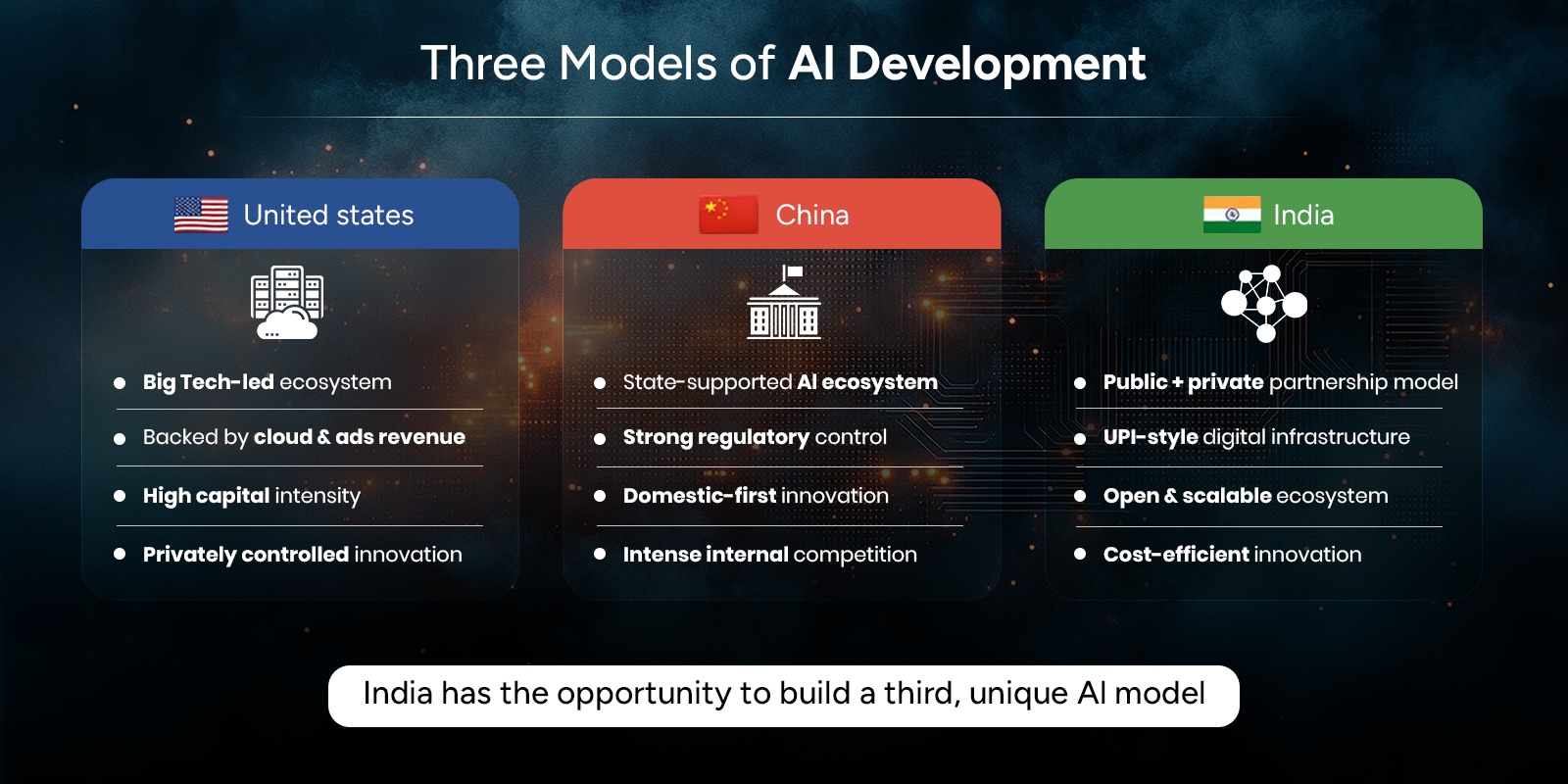
Most frontier models today are built in the United States, typically on the back of highly profitable technology platforms. Companies like Google, Amazon, and Microsoft subsidise the massive capital required to build these models through their existing profit centres - cloud, advertising, and enterprise software. This is the American model: high capital intensity, deep research capability, and large risk-taking institutions.
China, on the other hand, is evolving a different paradigm, one where foundation models are developed within a tightly controlled ecosystem, supported by significant government funding and intense domestic competition.
India must chart its own path.
We have already demonstrated that public digital infrastructure combined with private innovation can scale globally. The best example is the Unified Payments Interface (UPI), a highly successful public-private partnership in which the state built the rails and private companies built the products. The same philosophy can guide India’s AI strategy.
Why India Needs Its Own Foundation Models
India’s motivation for building sovereign AI goes far beyond technological prestige.
The country has 22 officially recognised languages and more than a thousand mother tongues. Yet most global language models are trained overwhelmingly on English. Standard tokenisation systems, optimised for Roman scripts, are extremely inefficient when processing Indian writing systems like Devanagari, Tamil, Bengali, Telugu, or Malayalam.
Even more uniquely, Indian communication is dominated by code-switching - the everyday mixing of languages such as Hindi and English or Tamil and English in the same sentence. Models trained on monolingual corpora struggle to interpret this linguistic fluidity.
This creates both a challenge and a massive opportunity for Indian AI startups.
Strategic Importance of Sovereign Models
The case for sovereign foundation models becomes even stronger in critical sectors such as space, defence, finance, and regulation.
Institutions like the Indian Space Research Organisation, Ministry of Defence, Securities and Exchange Board of India, and the Reserve Bank of India operate on highly sensitive datasets - satellite telemetry, battlefield intelligence, financial transactions, and market surveillance data.
Relying entirely on foreign AI models in such domains raises several risks:
Data security and sovereignty
Regulatory compliance
Geopolitical dependencies
Lack of domain-specific training
These developments are also beginning to intersect with sectors that attract aerospace startup investment in India, where AI is increasingly important in satellite analytics, defence simulations, and space technology platforms.
Just as UPI transformed digital payments, sovereign AI models can become the strategic AI backbone for national institutions.
The Architecture Is Not the Hard Part
Building a language model involves two very different components. First, the architecture blueprint - the design of the neural network itself. Second, the trained model, which emerges from massive data, engineering, and computation.
The good news is that the architectural blueprint for modern LLMs is largely open science. India does not need to reinvent the wheel. The modern LLM ecosystem already offers several powerful architectural innovations:.
Transformer architecture pioneered by Google.
Mixture of Experts (MoE) architectures popularised by DeepSeek.
Efficiency improvements from the LLaMA stack developed by Meta
RLHF alignment techniques developed by OpenAI
Long-context attention architectures from Anthropic
Many national AI programs worldwide are already leveraging these open architectures to build sovereign models.
Where the Real Work Lies
The true challenge lies not in architecture, but in data, tokenisation, and data pipelines.
Indian models will need custom tokenisers specifically designed for Indian scripts. Standard multilingual models often require four to eight tokens to represent a single Hindi or Bengali word. An Indic-optimised tokeniser can reduce this to one or two tokens, making models three to four times more efficient.
The next major challenge is training data. Training a competitive foundation model requires roughly a trillion tokens spanning:
Web content.
Computer code
mathematics.
Scientific literature.
Multilingual conversational text.
This dataset must include dozens of Indian languages, including low-resource languages such as Kashmiri, Sindhi, Dogri, and Konkani, where digital text barely exists today.
India’s AI Infrastructure Moment
According to Viksit Bharat, recognising this opportunity, the Government of India launched the IndiaAI Mission with an outlay of ₹10,371 crore over five years, led by the Ministry of Electronics and Information Technology.
Two major pillars are enabling India’s foundation model ecosystem:
India AI Compute Portal
Over 38,000 GPUs have been onboarded and made available to startups and researchers at subsidised rates.
AI-Kosh Data Platform
A national repository hosting 10,000+ datasets and hundreds of AI models across 20 sectors, designed to improve data quality and accelerate model training.
The first wave of foundation model startups supported under the mission includes companies such as Sarvam AI, Soket AI, Gnani AI, and Gan AI, working on multilingual and voice-based AI capabilities.
As sovereign AI infrastructure expands, it is expected to attract more capital from deep-tech VC, Indian defence investors, and funds focused on aerospace startup investment, all of which see AI as a foundational technology for future national capabilities.
The Next Decade
Foundation models are ultimately judged on a few key metrics:
scale (parameters)
learning (training tokens)
intelligence (benchmarks)
efficiency (inference cost and speed)
real-world usefulness
The next decade will determine which countries control the foundational AI layer of the global economy. India has the ingredients - talent, linguistic diversity, digital infrastructure, and a massive domestic market.
The Road Ahead
For founders and investors exploring deep tech, defence, and aerospace opportunities in India, the rise of sovereign foundation models is a key frontier, and at India Accelerator, we help founders scale breakthrough AI, defence, and space technologies into globally impactful ventures.
FAQs
Q1: What are sovereign foundation models, and why are they important for India?
A1: Sovereign foundation models are AI systems built and trained within a country using its own data, infrastructure, and regulatory frameworks. For India, they are critical to ensuring data security, linguistic representation, and independence from foreign AI systems, especially in sensitive sectors such as defence, finance, and governance.
Q2: Why can’t India rely entirely on global foundation models?
A2: Most global models are trained primarily on English data and optimised for Western use cases. They often struggle with Indian languages, scripts, and code-switching patterns. Additionally, reliance on foreign models raises concerns around data sovereignty, compliance, and geopolitical risks.
Q3: What role do Indian languages play in building AI models?
A3: India’s linguistic diversity, including 22 official languages and hundreds of dialects, makes it essential to build AI systems tailored to local languages. Custom tokenisation and datasets are required to efficiently process scripts like Devanagari, Tamil, and Bengali, as well as mixed-language communication commonly used in India.
Q4: How is India supporting the development of its AI ecosystem?
A4: The Government of India is actively supporting AI innovation through initiatives like the IndiaAI Mission, which provides access to compute infrastructure (GPUs) and curated datasets via platforms such as AI-Kosh. These efforts aim to enable startups and researchers to build scalable, high-performance AI systems within the country.
Check Out More Blogs
Drones, AI and the New Battlefield: How Indian Startups Are Modernising National Security
Nations are rapidly shifting conflict to the skies and cyberspace, and traditional defence systems no longer guarantee strategic advantage.
![[object Object]](/_next/image/?url=https%3A%2F%2Fwebsite.indiaaccelerator.live%2Fwp-content%2Fuploads%2F2026%2F04%2FWhatsApp-Image-2026-04-01-at-10.45.24-AM-2.jpeg&w=3840&q=75)
The Case for Sovereign Foundation Models in India
Artificial intelligence is rapidly becoming the infrastructure layer of the digital economy, and foundation models are the engines powering it.
![[object Object]](/_next/image/?url=https%3A%2F%2Fwebsite.indiaaccelerator.live%2Fwp-content%2Fuploads%2F2026%2F03%2FWhatsApp-Image-2026-03-24-at-12.16.09-PM.jpeg&w=3840&q=75)
The EHR Was Built for Billing, Not Care. A New Wave of Startups Is Fixing That with LLMs
![[object Object]](/_next/image/?url=https%3A%2F%2Fwebsite.indiaaccelerator.live%2Fwp-content%2Fuploads%2F2026%2F03%2FWhatsApp-Image-2026-03-18-at-2.51.26-PM.jpeg&w=3840&q=75)
![[object Object]](/_next/image/?url=https%3A%2F%2Fwebsite.indiaaccelerator.live%2Fwp-content%2Fuploads%2F2026%2F03%2FBlog-Banner-4.5.png&w=3840&q=75)
Building India’s space supply chain:
The multibillion-dollar opportunity for SpaceTech Startups
![[object Object]](/_next/image/?url=https%3A%2F%2Fwebsite.indiaaccelerator.live%2Fwp-content%2Fuploads%2F2026%2F02%2FWhatsApp-Image-2026-02-25-at-6.13.13-PM-1.jpeg&w=3840&q=75)
India’s Next Deeptech Frontier
Semiconductors, Photonics, FPGA & Intelligent Software
![[object Object]](/_next/image/?url=https%3A%2F%2Fwebsite.indiaaccelerator.live%2Fwp-content%2Fuploads%2F2025%2F11%2FWhatsApp-Image-2025-11-27-at-11.47.44_0683d5c9.jpg&w=3840&q=75)
The Next Battlefield: How AI Is Redefining Modern Warfare
With the rise of artificial intelligence, even warfare is beginning to take an AI-first approach.
![[object Object]](/_next/image/?url=https%3A%2F%2Fwebsite.indiaaccelerator.live%2Fwp-content%2Fuploads%2F2025%2F08%2F1747893109578.png&w=1920&q=75)
Are we any better than monkey?
We are just an advanced breed of monkeys on a minor planet of a very average star. But we can understand the (Startup) Universe. That makes us something very special.
![[object Object]](/_next/image/?url=https%3A%2F%2Fwebsite.indiaaccelerator.live%2Fwp-content%2Fuploads%2F2025%2F01%2FGroup-43299-1.png&w=640&q=75)
The Future of Electric Mobility in India: Key Insights from 2024
As a VC fund focused on mobility and EV innovation, we’ve evaluated 500+ startups and engaged deeply with over 100 founders and industry leaders this year. Through these interactions, we’ve observed incredible momentum and inspiring stories shaping the future of electric mobility in India. The ecosystem has made impressive progress, from localized battery innovations to disruptive last-mile solutions. However, challenges in affordability, infrastructure, and technology integration persist, leaving significant room for innovation and reform.
![[object Object]](/_next/image/?url=https%3A%2F%2Fwebsite.indiaaccelerator.live%2Fwp-content%2Fuploads%2F2025%2F01%2FElectric-Mobility.png&w=640&q=75)
Abhimanyu must get out this time
Stepping into the entrepreneurial world takes courage and skill, but successfully navigating its challenges and achieving a successful exit requires a blend of strategy, adaptability, and support.
![[object Object]](https://website.indiaaccelerator.live/wp-content/uploads/2025/01/Abhimanyu.svg)