April 1, 2026
Drones, AI and the New Battlefield: How Indian Startups Are Modernising National Security
Nations are rapidly shifting conflict to the skies and cyberspace, and traditional defence systems no longer guarantee strategic advantage.

Arindam Mukhopadhyay
Partner @ VC | India Accelerator & Finvolve | Seed to pre-IPO

Index
Introduction
Nations are rapidly shifting conflict to the skies and cyberspace, and traditional defence systems no longer guarantee strategic advantage. The future of national security now sits at the intersection of artificial intelligence, autonomous systems, and software-defined hardware, and Indian startups are leading this transformation.
A new class of AI led defence tech startup is emerging. These companies combine advanced computer vision, edge computing, and intelligent autonomy to redefine how unmanned aerial vehicles (UAVs) operate, how systems detect threats, and how forces perceive battlefields.
Vision Beyond GPS: Autonomy in Contested Environments
Modern combat scenarios rarely offer reliable GPS navigation. In GPS-denied, jammed, or spoofed environments, legacy systems fail. Indian startups are tackling this challenge head-on by building vision-based navigation systems powered by onboard cameras and SLAM (Simultaneous Localisation and Mapping) algorithms.
These systems allow drones to map and localise themselves in real time, ensuring precise mission execution even when traditional navigation aids fail. Instead of depending on external signals, drones can now ‘see’ their surroundings, interpret terrain, identify obstacles, and autonomously plan routes, marking a critical leap toward resilient autonomy.
Edge AI: Bringing Smarts to the Air
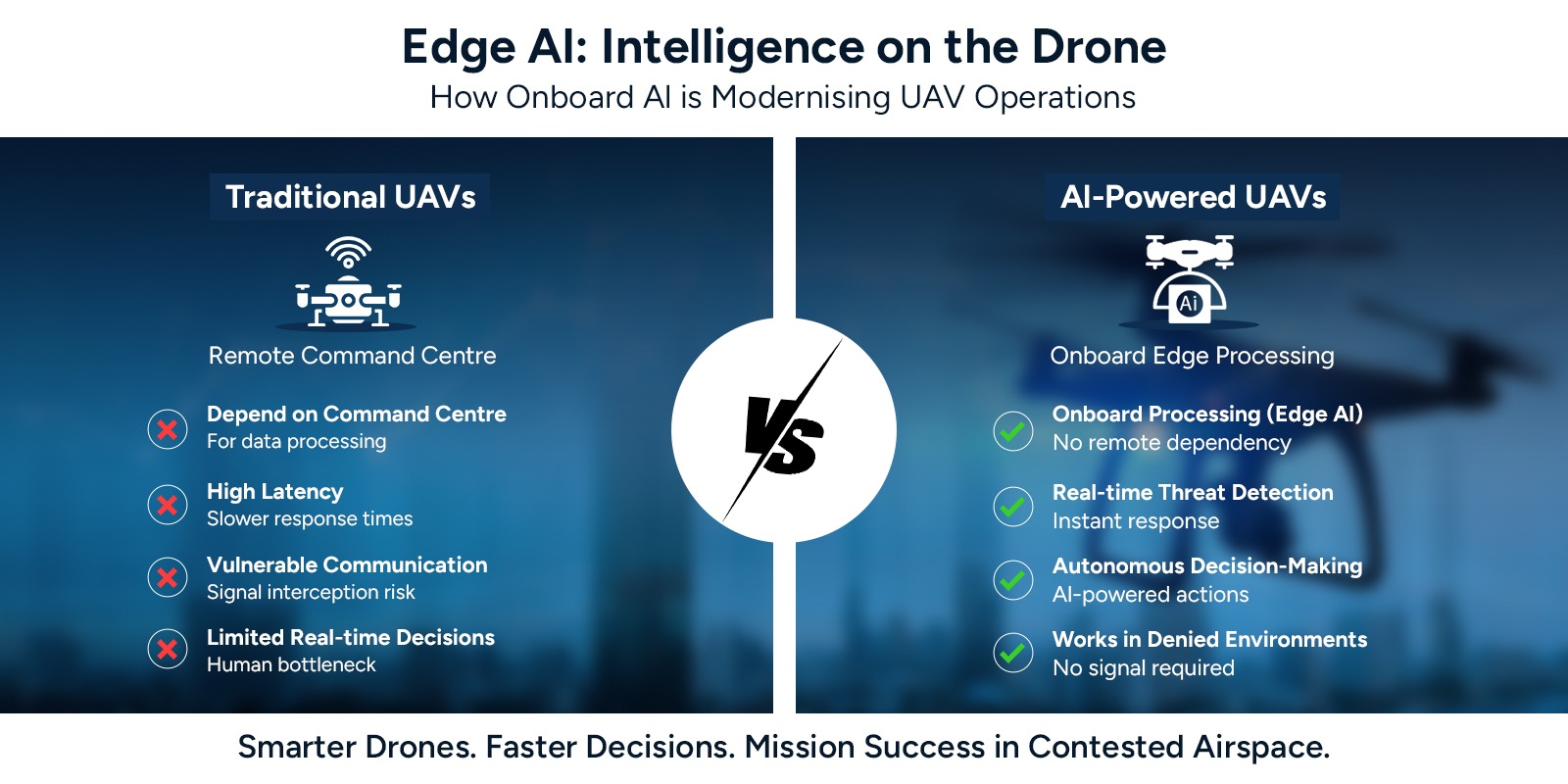
Traditional UAV operations rely heavily on remote command centres for computationally intensive tasks, which creates latency and vulnerability. Edge computing changes this dynamic by enabling drones to process data onboard.
Modern UAVs equipped with GPUs and neural accelerators can now:
- Perform real-time object recognition
- Detect and engage threats
- Optimise routes dynamically
- Make decisions independently without the command centre's intervention
- Reducing bandwidth is not just about efficiency; it directly impacts survival in contested airspace. This shift also makes drones far more resilient to communication disruptions.
Indoor Autonomy and Reinforcement Learning
Modern conflicts often unfold in indoor and dense urban environments where GPS cannot function effectively. Indian defence startups are actively solving this challenge.
They use perception models that combine computer vision, 3D mapping, and object detection to help autonomous systems understand their surroundings in real time. These systems can identify terrain features, classify structures, and avoid obstacles, improving mission planning while minimising collateral damage.
Reinforcement learning plays a crucial role here. Startups train simulation agents using real-world feedback, enabling drones to navigate complex environments and adapt dynamically without human intervention.
Swarm Intelligence: The Power of Collective Autonomy
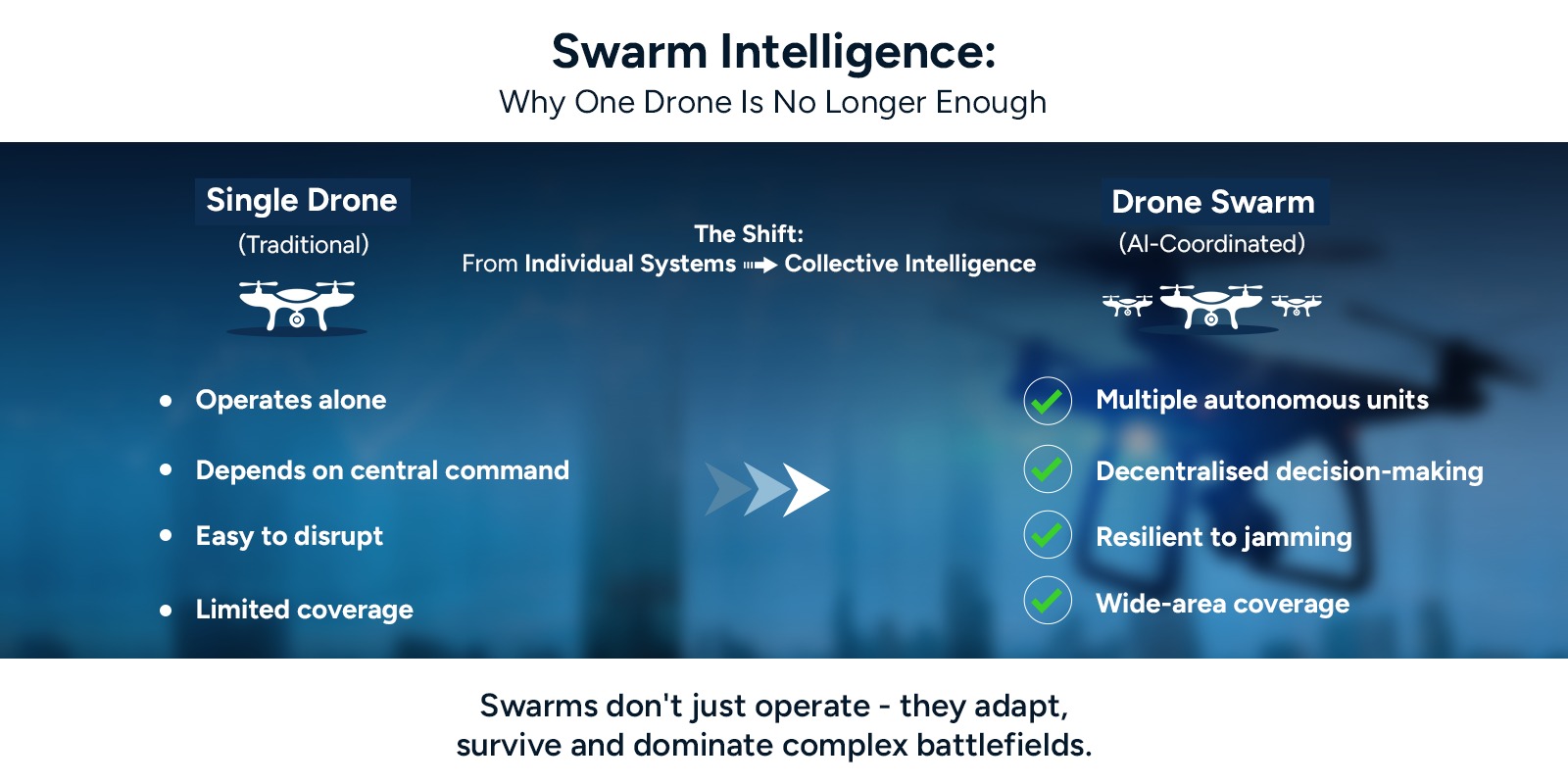
A single intelligent drone is powerful, but coordinated swarms redefine warfare.
Indian startups are developing swarm-capable systems that operate without relying on fragile RF communications. Instead, they use vision-based coordination, relative positioning, and distributed algorithms to maintain in cohesion even in jammed or intercepted environments.
These swarms can reconfigure formations, overwhelm defences, and maintain mission continuity. By adapting dynamically to battlefield conditions, they deliver both redundancy and tactical flexibility.
Anti-Drone Innovation: Hard-Kill Capabilities from Indian Startups
As UAV threats continue to rise, from malicious commercial drones to adversarial surveillance systems, Indian startups are rapidly advancing anti-drone system India startup solutions.
Instead of relying only on electronic countermeasures, they are building systems that use advanced vision technologies to:
- Detect hostile UAVs
- Track and classify threats
- Predict flight trajectories
- Execute hard-kill intercepts using autonomous interceptor drones
This approach creates an active defence layer that can neutralise low-cost aerial threats that might evade traditional jamming systems.
Multi-Sensor Fusion: A Unified Battlefield Picture
Individual sensors provide limited insights, but combining multiple data sources creates a far more accurate picture.
Indian defence startups are integrating data from EO/IR cameras, RF sensors, acoustic systems, and radar to build unified situational awareness. This fusion reduces false alarms, improves detection of stealth threats, and enhances classification accuracy across diverse environments.
AI-driven analytics then transform this data into actionable intelligence, enabling faster and more informed decision-making.
AI-Native Decision Analytics: Faster Than Human Reaction
The true advantage of these technologies lies in decision-making speed.
AI systems analyse fused sensor data, prioritise threats, simulate outcomes, and recommend actions in real time. Human operators remain in the loop, but they no longer act as bottlenecks. This balance ensures both speed and control in high-pressure situations.
A New Defence Ecosystem: Software-Defined and Rapidly Adaptive
Together, these innovations, vision-based autonomy, edge AI, reinforcement learning, swarm intelligence, hard-kill counter-UAV systems, and multi-sensor fusion, represent more than incremental improvements.
They mark a fundamental shift: From hardware-heavy, signal-dependent systems to agile, software-defined, AI-native defence platforms that evolve with emerging threats.
Indian defence-tech startups are not just building tools; they are redefining the strategic framework of national security in the 21st century.
Why This Matters: India’s Strategic Edge
India’s defence innovation ecosystem has moved beyond traditional procurement cycles. With global defence spending projected to exceed $2 trillion annually by 2027 and UAV threats rising rapidly, Indian startups are positioning the country as a leader in autonomous warfare.
AI defence innovation continues to accelerate, and anti-drone system India startup solutions are advancing quickly. India is shifting from reactive defence to predictive, resilient, and adaptive security systems.
The Path Forward
India’s defence future will depend on how quickly it scales innovations from AI defence startups and anti-drone system startups into real-world deployment. The next phase requires deeper collaboration between startups, defence forces and policymakers. Turning innovation into on-ground capability will define India’s strategic advantage.
FAQs
Q1: How are Indian startups transforming national security with AI and drones?
A1: Indian startups are building autonomous drones, smart surveillance systems and AI-driven threat detection platforms. These technologies enable faster decision-making, higher mission accuracy and stronger defence capabilities.
Q2: What role do anti-drone systems play in modern defence?
A2: Anti-drone systems detect, track and neutralise hostile UAVs using radar, RF sensing, AI-powered vision systems and interception capabilities. They protect critical infrastructure from low-cost aerial threats.
Q3: Why is edge AI important for defence applications?
A3: Edge AI allows systems to process data locally in real time, reducing latency and ensuring operations continue even when communication links fail.
Q4: How does India Accelerator support defence-tech startups in India?
A4: India Accelerator being one of the most active defence tech investors, provides strategic guidance and connections that help startups scale and deploy advanced technologies faster beyond funding.
Q5: What is the future of AI led defence tech startups in India?
A5: AI defence startups will continue advancing autonomous systems, swarm intelligence and multi-sensor analytics. Stronger collaboration across the ecosystem will position India as a global leader in next-generation defence technology.
Check Out More Blogs
Drones, AI and the New Battlefield: How Indian Startups Are Modernising National Security
Nations are rapidly shifting conflict to the skies and cyberspace, and traditional defence systems no longer guarantee strategic advantage.
![[object Object]](/_next/image/?url=https%3A%2F%2Fwebsite.indiaaccelerator.live%2Fwp-content%2Fuploads%2F2026%2F04%2FWhatsApp-Image-2026-04-01-at-10.45.24-AM-2.jpeg&w=3840&q=75)
The Case for Sovereign Foundation Models in India
Artificial intelligence is rapidly becoming the infrastructure layer of the digital economy, and foundation models are the engines powering it.
![[object Object]](/_next/image/?url=https%3A%2F%2Fwebsite.indiaaccelerator.live%2Fwp-content%2Fuploads%2F2026%2F03%2FWhatsApp-Image-2026-03-24-at-12.16.09-PM.jpeg&w=3840&q=75)
The EHR Was Built for Billing, Not Care. A New Wave of Startups Is Fixing That with LLMs
![[object Object]](/_next/image/?url=https%3A%2F%2Fwebsite.indiaaccelerator.live%2Fwp-content%2Fuploads%2F2026%2F03%2FWhatsApp-Image-2026-03-18-at-2.51.26-PM.jpeg&w=3840&q=75)
![[object Object]](/_next/image/?url=https%3A%2F%2Fwebsite.indiaaccelerator.live%2Fwp-content%2Fuploads%2F2026%2F03%2FBlog-Banner-4.5.png&w=3840&q=75)
Building India’s space supply chain:
The multibillion-dollar opportunity for SpaceTech Startups
![[object Object]](/_next/image/?url=https%3A%2F%2Fwebsite.indiaaccelerator.live%2Fwp-content%2Fuploads%2F2026%2F02%2FWhatsApp-Image-2026-02-25-at-6.13.13-PM-1.jpeg&w=3840&q=75)
India’s Next Deeptech Frontier
Semiconductors, Photonics, FPGA & Intelligent Software
![[object Object]](/_next/image/?url=https%3A%2F%2Fwebsite.indiaaccelerator.live%2Fwp-content%2Fuploads%2F2025%2F11%2FWhatsApp-Image-2025-11-27-at-11.47.44_0683d5c9.jpg&w=3840&q=75)
The Next Battlefield: How AI Is Redefining Modern Warfare
With the rise of artificial intelligence, even warfare is beginning to take an AI-first approach.
![[object Object]](/_next/image/?url=https%3A%2F%2Fwebsite.indiaaccelerator.live%2Fwp-content%2Fuploads%2F2025%2F08%2F1747893109578.png&w=1920&q=75)
Are we any better than monkey?
We are just an advanced breed of monkeys on a minor planet of a very average star. But we can understand the (Startup) Universe. That makes us something very special.
![[object Object]](/_next/image/?url=https%3A%2F%2Fwebsite.indiaaccelerator.live%2Fwp-content%2Fuploads%2F2025%2F01%2FGroup-43299-1.png&w=640&q=75)
The Future of Electric Mobility in India: Key Insights from 2024
As a VC fund focused on mobility and EV innovation, we’ve evaluated 500+ startups and engaged deeply with over 100 founders and industry leaders this year. Through these interactions, we’ve observed incredible momentum and inspiring stories shaping the future of electric mobility in India. The ecosystem has made impressive progress, from localized battery innovations to disruptive last-mile solutions. However, challenges in affordability, infrastructure, and technology integration persist, leaving significant room for innovation and reform.
![[object Object]](/_next/image/?url=https%3A%2F%2Fwebsite.indiaaccelerator.live%2Fwp-content%2Fuploads%2F2025%2F01%2FElectric-Mobility.png&w=640&q=75)
Abhimanyu must get out this time
Stepping into the entrepreneurial world takes courage and skill, but successfully navigating its challenges and achieving a successful exit requires a blend of strategy, adaptability, and support.
![[object Object]](https://website.indiaaccelerator.live/wp-content/uploads/2025/01/Abhimanyu.svg)